Sunday, 2 March 2014

Radio and Weather Statistics for February 2014

February 2014 has continued wet with many floods across the country.

My radio and weather statistics for January are as follows:

Radio Operation

Total number of contacts: 34

Modes

JT65:  34

A poor month again for radio operation, not much time to get on.

Weather

Total rainfall for the month: 132mm

Average temperature: 6.6 degrees centigrade

Maximum temperature of 12.9 on the 24th February at 14.34
Minimum temperature of 1.7 on the 28th February at 00:57


The weather during the month has again been very wet and windy with a succession of low pressure areas running from the Atlantic across the country. As can be seen from the minimum temperature being above freezing point it has also been a mild month.

Tuesday, 18 February 2014

A Cloud Free Day - Satellite Picture of Flooding

Sunday was a rare day of sunshine and clear blue skies. The weather satellite pictures received via EUMETCast showed the UK in a rare state of being almost cloud free.

The following picture shows the UK from a Metop AVHRR pass.


© EUMETSAT (2014)

It is not really clear from the above picture, but when viewed on a large screen, flooding along the River Thames and the Somerset Levels stands out very well.

I took the following detail from the above picture. This shows the Somerset Levels area with the extensive flooding clearly visible. It will be interesting to compare this with a picture later in the year when hopefully the area has dried out.

© EUMETSAT (2014)
 
After the storm overnight Friday into Saturday, the weather has improved, although still some rain, not as heavy as previous weeks.
 

Sunday, 16 February 2014

JT65 Activity on 10m

The 10m band has been very good recently with plenty of JT65 activity.

Have not had much time for radio recently, however did get an hour yesterday evening and put out a call on 10m using the JT65 mode.

Worked the following stations in an hour:

KI0QS
WB0IKF
W9TLG
LU4WAP
W9MDB
KM6CQ
KB1O
KF7GMV
N8BIF

Plenty of stations on from North and South America and very difficult to find any free space on the JT65 frequency.

Did not get a chance to try out SSB on 10m. The Windom antenna had blown down in the rceent strong winds, so the Inverted L which I usually use on the FT2000 was connected to the TS2000 which is set up for data modes.

Friday, 14 February 2014

A Conveyor of Low Pressure Areas

So far this year, we have seen a succession of low pressure areas come across the Atlantic straight for the UK, dumping large amounts of rainfall and inflicting very high winds across the country.

Rainfall has been heaviest in the south of the country with heavy flooding in Somerset and across the Thames Valley.

The cause appears to be the jet stream stuck further south and flowing faster than usual, generating a conveyor belt of fast moving, intense low pressure areas.

I had a look through the NOAA APT satellite pictures I have received for the last few weeks and picked out a series of pictures that give an indication of this weather pattern

They all show intense low pressure areas tracking over the UK.

 NOAA 19 - 1st February 2014

NOAA 19 - 7th February 2014

NOAA 19 - 8th February 2014

NOAA 19 - 12th February 2014

The last picture from the 12th February brought very strong winds to the west and north of the country with gusts in excess of 100MPH.

We have yet another low pressure area tracking across the country through today and overnight bringing rain and gale force winds. There was too much noise on the NOAA 19 midday picture from today. The cross dipoles I use to received APT transmissions are located in the loft of the house. We have a large number of tall trees to the south and what with the rain and thick cloud, I suspect this combines to impact the signal received from the satellite.

Saturday, 1 February 2014

Radio and Weather Statistics for January 2014

January 2014 has been a terrible month with so much rain that here in the south of the UK it has been the wettest January on record.

My radio and weather statistics for January are as follows:

Radio Operation

Total number of contacts: 18

Modes

JT65:  12
SSB:   6
A poor month for radio operation, not much time to get on.

Weather

Total rainfall for the month: 177mm

Average temperature: 6 degrees centigrade

Maximum temperature of 11.9 on the 6th January at 00:22
Minimum temperature of -1.9 on the 12th January at 05:03

Frost days: 4

The weather during the month has been very wet and windy with a succession of low pressure areas running from the Atlantic across the country.

Monday, 27 January 2014

Raspberry Pi NTP Server

I run a number of applications such as WSPR which require accurate timing. PC clocks are very poor at keeping accurate time and rather than rely on an internet time source, I have run my own NTP server based on a Garmin GPS unit for some years. This is connected to a computer running Windows XP which takes the GPS data and the PPS signal to provide a very accurate time.

As this system is now many years old, I have been looking for an alternative solution and found a build using a Raspberry Pi and a GPS.

I have also been wanting to play with the Raspberry Pi so this looked like an ideal project, so I ordered the parts last week and completed over the weekend.

I must make clear that none of this is my own original work. I followed the instructions and downloads from:

David Taylor at this link: http://www.satsignal.eu/ntp/Raspberry-Pi-NTP.html#trimble

The download and information from: http://ntpi.openchaos.org/downloads/ and http://ava.upuaut.net/?p=612

And the GPS add-on board from here: http://ava.upuaut.net/store/index.php?route=product/product&path=59_60&product_id=95

I would like to thank them for the information, downloads and GPS board they have made available to create an incredibly simple to construct and cheap NTP server.

The first stage was connecting the GPS board to the Raspberry Pi. This was simply a matter of plugging the two units together using the GPIO pins. An antenna is then connected to the GPS board.

The following photo shows the Raspberry Pi with the GPS board added:


The add on GPS board is at top left with the cable attached to the GPS antenna.

After downloading the image, this was written to a new SD card using Win32DiskImager.

The SD card was inserted in the Raspberry Pi, power connected and the system came up and running as an NTP server.

To monitor time on my computers I use NTP Time Server Monitor by Meinberg. The following picture shows the Time Server Monitor screen on one of my PCs:


!92.168.1.85 is the new Raspberry Pi NTP server and 192.168.1.5 is the original NTP server on the Windows XP machine.

Really remarkable how simple it was to put this project together and my thanks to those who had put together the image, instructions and made available a compatible GPS board for all this to work so easily.

Also a good start with the Raspberry Pi, a remarkable little computer which seems to offer no end of possibilities for building simple applications to perform specific functions.

Sunday, 26 January 2014

QSL Cards from the Bureau

Received a batch of QSL cards in the post last week for my MQ5LMY and MO5LMY call signs celebrating the Queen's Jubilee and the Olympics in 2012.


If your call is amongst them, many thanks for sending the card. My special event QSL cards were sent to the bureau at the start of last year so hopefully you have received mine.

Sunday, 19 January 2014

Birdbox Webcam

Yesterday was one of those rare days at the moment where we had some dry weather, so I took the opportunity to clean out the birdbox at the side of the house and make sure the camera was set up and working.

There was a Blue Tit nest in the box last year which was reasonably successful in that some of the chicks fledged. I try and get the box ready around Christmas as birds start looking for nesting sites at the start of the year if the weather is reasonably mild.

The following picture shows the box mounted next to the side of the house.


The box on the side houses the connecting block between the cables leading to the computer and the camera.

The camera is this small CCTV camera from Henry's mounted on the lid of the box facing down. I have also included a white LED in the box which is always on to add some light.

The camera is cabled to one of my Shed Computers which runs CamUniversal from Crazypixels.

CamUniversal is configured for motion detection, comparing pictures every 5 seconds and saving pictures if there is a change. This ensures that any activity in the box is captured. CamUniversal is also configured to save a picture every 60 seconds. This is then uploaded to my monitoring web site so I can check any build up of activity and whether nesting has started.

The weather today has been a significant improvement on recent weeks with plenty of sunshine and this seems to have prompted some immediate inspections of the birdbox. Checking the folder which holds pictures taken when motion is detected I found a number with a bird checking out the box. See the following as an example:


Hopefully nest building may start soon and I shall have another successful nest in 2014.

If you want to check what is happening, the 60 second snapshot can be found here.

Friday, 3 January 2014

Weather Report: Continuing Stormy Weather

The stormy weather continues. Heavy rain, hail and winds again today with a low pressure area to the north of Scotland resulting in fast moving heavy belts of rain moving across my location in the south of England.

NOAA APT pictures continue to provide good views of the weather moving across the UK. The early morning and mid to late afternoon satellite passes are still to dark due to the low elevation of the sun at this time of year, however the passes around midday work well.


The above picture is from the NOAA 19, 13:07 pass and clearly shows the low pressure area to the north of Scotland and the stream of showers being fed from the Atlantic over the southern half of the UK.

Just before this pass, there was an intense storm at my location with heavy hail, rain and wind. The following graph is the temperature reading from my "computer shed" and shows the sudden drop in temperature at the onsite of the storm.


The drop is shown just after 12:00. the storm passed through in an hour.

Lots of flooding in the south west of England and along the south coast.

Aerials still holding up with no damage. Still more to come over the weekend !

Thursday, 2 January 2014

Weather Update: A Rare Break In The Rain

A rare day of clear sky and no rain although this is forecast to change later this evening with heavy rain and strong winds returning.

The following is the NOAA19 APT picture received early this afternoon and shows the cloud that produced yesterday's rain over central Europe and Scandinavia with the next low pressure area and cloud bringing this evening's and tomorrow's rainfall to the west, approaching from the Atlantic.


This has been the pattern for most of the last few weeks with a continuous series of low pressure areas spreading across the UK from the Atlantic bringing heavy wind and rain.

The ground is water logged and rivers running very high with localised flooding. The following photo is the Blackwater River not far from my home location.


The river is more than twice the size of normal and is very fast flowing. When I took this photo, the water had receded as the ground around the river had flooded and was still covered in many places.

So far, no aerial damage. The new M0CVO HW-40HP aerial I put up just before Christmas is working well and providing there are no more branches falling from the trees supporting the aerial it should be fine.

Wednesday, 1 January 2014

Radio and Weather Statistics for 2013

Well, the end of another year and some statistics from my radio operation during 2013 and from the M5LMY weather station:

Radio Operation

Total number of contacts: 978

Modes

JT65:  710
SSB:   229
PSK31: 39

Weather

Total rainfall for the year: 713mm

Average temperature: 9.5 degrees centigrade

Maximum temperature of 31.9 on the 13th July at 15:30
Minimum temperature of -4.2 on the 22nd January at 03:27

The weather at the end of the year has been very wet and windy with a succession of low pressure areas running from the Atlantic across the country. December alone had 105.4mm of rainfall.

January is starting the same with so far 9mm of rain.

Monday, 2 December 2013

Magnetometer Problems

Well, I have been testing the Magnetometer over the last couple of weeks and was hoping to report some success, however there is a basic problem which I cannot resolve.

A typical graph of the output I am getting is shown below.


The approx. 1280mV line is the initial output from the magnetometer which should then change dependent on changes to the magnetic field, however what seems to be happening is the output jumping to 1800mV (and superimposed on this level there does seem to be a fluctuating signal) before being pulled down to the initial output voltage, almost as if the device is being periodically reset and held at the reset voltage.

(The change between 13:30 and 14:00 was me checking the wiring again, switching off and on etc.)

There seems to be no logic to the frequency of these changes. I have checked and double checked all wiring, the circuit board etc. but cannot find any cause for this problem.

Not sure where to go now.

Monday, 28 October 2013

St Jude's Day Storm

A strong storm over the south of the country overnight and early this morning, which has been given the name of the St Jude's Day Storm.

No serious damage, however I lost my Off Centre dipole wire antenna after a branch from one of the trees in the garden came day.

On checking the garden I found this:


Repairs will have to wait until the weekend.

The strongest gust of wind that my weather system recorded was 37mph which is very low considering gusts of 70 to 80mph were recorded across the south of the country.

The wind speed is measured slightly above the ridge of the roof as shown in the following picture:


However, to the south (left of the above picture) we have a small wood with lots of tall trees. These have a shielding effect so we do not often get the full force of the wind so I always register lower wind speeds

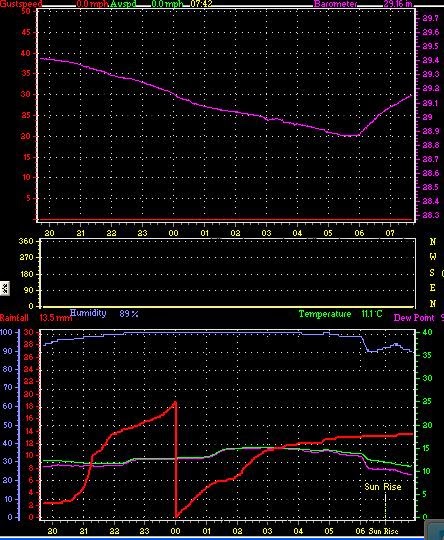
The following picture is a screen copy from my weather system which shows the change in pressure as the storm passed through (top graph):


The lower graph shows the rainfall (red line) which reset at midnight, showing the large amount of rain yesterday evening and this morning. The green line in the lower graph shows temperature. Interesting to note the fall in temperature coincides with the increase in air pressure in the top graph.

Thursday, 24 October 2013

JT65 Activity This Evening

I managed to spend some time on the radio this evening for some JT65-HF activity on 20m. Put out some CQ calls and worked the following stations:

DL7UM, KS3K, NW9T and 9Y4NW

9Y4NW in Trinidad and Tobago is I think a new one for me so many thanks for the call Neil.

I was called by KY7S in Seattle but unfortunately after the first call I could not decode anything more, so could not exchange signal reports.

Wednesday, 23 October 2013

Magnetometer Installed

Dodging the rain over the weekend I installed the Magnetometer in the garden.

The box with the sensor is buried below ground. The reason for this is to minimise the impact of temperature changes. I have found the sensor to be very sensitive to changes. In the garden also tries to distance the sensor from any moving metallic objects which may impact the readings.

The following shows the sensor box in position:


The compass on the box is to ensure there is correct alignment of the sensor along the east - west axis.

The box about to disappear (I did remove the compass before filling in!)


The control box with the processing electronics is mounted on a fence post in a water tight box.

This is connected to a PicoTech Enviromon system in the shed that monitors the output voltage and records the data. Software on the computer produces an updated graph every few minutes.

I will post some sample graphs to show the results. Hopefully this will work.

Monday, 21 October 2013

No Wonder I Was Getting A Poor SWR !!

A week ago I tried to tune my FT2000 on 40m via the external SGC Smart Tuner but it would not tune up and the meter on the FT2000 was showing an infinite SWR, not good!.

This weekend I was able to get outside on Sunday despite really bad weather and this is what I found:


No wonder it would not tune up.

The cable usually breaks where it passes through the insulator at the 90 degree bend in the inverted L. As shown in an earlier post, it is this insulator which has been up for so long that the majority of the insulator has been engulfed in the branch. It was originally loose, held by some rope around the branch, this was 14 years ago when I first received the M5LMY licence which meant I could get on the HF bands.

Over those 14 years, the branch has gradually grown around the rope, then the insulator so that now more than 50% is buried within the branch. In another 5 to 8 years I guess it will disappear altogether.

The cable breaks at this point as there is no flexibility with the insulator so the cable is rubbing on the fixed insulator and wears through.

The weather yesterday has really bad. Raining for much of the day with some intense bursts along with thunder and lightning. The following is from my weather station, the red line showing rainfall:


In total today we had 22.4mm of rain.

Sunday, 20 October 2013


Conditions seem to be improving on 10m recently. The following is a snapshot of the map from wsprnet.org yesterday evening showing where my signal had been heard.


This is running 5w to a very small random length of wire, hidden within some conifer trees, fed via an auto tuner.

Not much activity recently, mainly due to work. One JT65 contact with K8QZ on Friday evening.

Monday, 23 September 2013

A Day of Activity

It was grey and overcast here in the south of the UK yesterday so a good day to play radio.

It was Railways on the Air weekend so there were a number of special event stations to work. I managed to get 13 stations in the logbook.

I spent some time during the evening working JT65 on 20M.


The above is a snapshot of my screen showing an hour's activity during the evening. For this mode, I use my Kenwood TS2000 running into an M0CVO HW-40HP antenna. This system works really well on all bands from 40m through to 10m with the internal ATU on the TS2000.

JT65 is my preferred data mode at the moment. It supports long distance working with low power I get called by the type of DX that I could never work using SSB.


Wednesday, 18 September 2013

MV5LMY QSL Cards

I used the "V" prefix earlier this year which was issued to mark the centenary of the RSGB. My call sign was MV5LMY. The RSGB also designed a couple of special QSL designs, I ordered one of these and have now received my pack of cards ready to complete details and send:


This is the "Art Deco" design. I selected this design as it is very similar to my first QSL card when I was G8LMY back in 1977. This original card also had a red map of the country to the right of the card.

Now just need to write them all and send via the bureau.

Monday, 16 September 2013

A Weekend of Bad Weather

The weekend weather here in the south of the UK has been terrible. Grey sky, rain and winds. The following satellite picture from Sunday gives a good view of the weather we were under:


This is the NOAA 19 pass from Sunday at 12:55. Ireland was generally cloud free and the north of the UK had some breaks in the cloud, however a large sweep of cloud over the south of the country.

Another good satellite pass from the north of Africa to Iceland. Not bad for a loft mounted pair of crossed diploes.